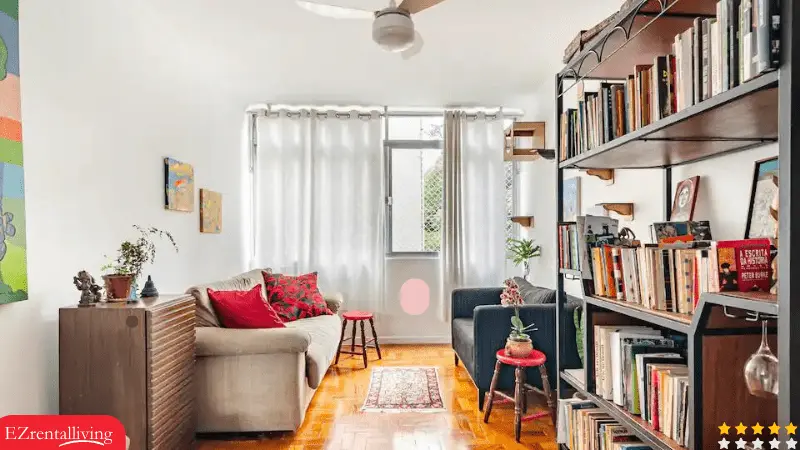
A small apartment does not have to feel small. The same space can feel cramped, or calm, bright and open — and the difference is rarely a renovation. It is light, colour, furniture size, and how much floor your eye can see. Most tricks below need no painting, no drilling, and no big budget. For more rental advice, browse our Apartment Guides.
TL;DR: How to Make a Small Apartment Look Bigger
- Add light at three heights — floor lamp, table lamp, and one low light — so no corner stays dark.
- Keep windows and sightlines clear so daylight can travel across the room.
- Stick to light colours and a 2–3 colour palette for your biggest pieces.
- Choose leggy, low-profile furniture and float it a few inches off the wall.
- Lean one large mirror near a window — it doubles light and depth.
- Go vertical with storage, zone with rugs and light, and declutter so everything has a home.
1. Add Light at Three Heights
Light is the biggest factor in how large a room feels. One ceiling light leaves dark corners, and dark corners make walls feel closer.
Place light at three levels: a floor lamp (60 to 70 inches tall), a table lamp at seating height, and one low lamp on a bookshelf. Together they spread light evenly. Use warm bulbs at 2700K to 3000K so the room feels bright, not clinical.
2. Keep Windows and Sightlines Clear
Daylight does more for a small space than almost anything you can buy. Pull curtains and blinds fully clear of the glass, and keep bulky furniture — anything taller than about 30 inches — away from the window. A tall bookcase there blocks light and cuts the room in half. A leaning mirror is the exception, because it reflects light back in.
Stand in your front door: can your eye travel to the far window without stopping? That long, clear sightline is what makes a small apartment feel open — especially in a studio apartment vs 1 bedroom.
3. Use Light Colours and a 2–3 Colour Palette
Light colours reflect more light and blur the edges between objects. When your biggest pieces match the wall colour, they melt into the background instead of standing out as separate blocks.
Keep your largest items — sofa, bedding, rug, and curtains — in warm white, cream, oatmeal, or pale greige. Stick to two or three main colours, adding contrast only in small doses. You do not need paint: swapping textiles usually costs $50 to $300 and takes an afternoon.
4. Choose Leggy, Low-Profile Furniture
The more floor your eye can see, the bigger the room feels. Furniture with slim, raised legs outperforms bulky pieces that sit flat on the ground: you can see the floor running underneath, and the room reads as one continuous space.
Look for sofas, chairs, beds, and dressers on legs with at least 6 inches of clearance, and seating backs around 30 to 34 inches high. An apartment-sized sofa is usually 72 to 84 inches wide, versus 90 inches or more for a standard one. If you are starting from scratch, see how to furnish an apartment on a budget.
5. Right-Size and Float Your Furniture Off the Walls
Pushing every piece hard against the wall feels logical, but it often makes a room feel more cramped. Pulling furniture slightly off the walls creates breathing room and depth.
Aim for 30 to 36 inches for main paths, 14 to 18 inches between sofa and coffee table, and pull the sofa 3 to 6 inches off the wall. One well-sized sofa beats a too-big sectional plus an armchair squeezed in beside it.
6. Lean a Large Mirror Near a Window
Mirrors work best when they reflect something worth doubling, like daylight or a view. A large mirror opposite or beside a window doubles the daylight and creates an illusion of depth.
Lean a floor mirror of about 60 to 65 inches tall next to or across from your window. Floor mirrors usually run $60 to $200, and setup takes about 15 minutes — no drilling needed. Skip small decorative mirrors: one big mirror makes a real difference, and never hang one where it reflects clutter.
7. Go Vertical With Storage: Up, Not Wider
Wall space is free real estate in a small apartment. Tall, slim shelving that runs close to the ceiling draws the eye upward, stores far more than a low, wide unit, and makes the ceiling feel higher.
Use tall bookcases, a vertical shoe cabinet, and shelving up to within a foot of the ceiling. Keep top shelves for rarely used things, and everyday items at eye level. In the kitchen and bathroom, stack, hang, and use door backs before buying another wide unit.
8. Zone With Rugs and Light, Not Walls
In an open-plan small apartment, every area can bleed into the next, and that makes the whole place feel messy and smaller. The fix is not a partition — it is a signal.
A rug under the sofa says “this is the living area”; one under the dining table says “this is where we eat.” A pendant lamp or floor lamp reinforces the zone without blocking light. Choose rugs large enough for at least the front legs of your furniture — a rug that is too small chops the room up.
9. Use Multi-Purpose Furniture
In a small home, single-purpose furniture is a luxury you cannot afford. Every piece should earn its place by doing two jobs.
Good examples: a storage ottoman that is also a seat, a sofa bed, a dining table with drawers, a lift-top coffee table, and a bed with drawers underneath. One strong multi-use piece per zone is enough. Check the space it needs in use: a sleeper sofa needs about 85 to 90 inches of clear floor in front of it when open.
10. Declutter — Then Give Everything a Home
Clutter shrinks a room faster than any furniture choice. If something has no home, it lives on a surface, and surfaces covered in objects make a room feel half its size.
Edit ruthlessly first: if you have not used it in a year, and it is not seasonal or sentimental, donate, sell, or store it elsewhere. Then give everything a specific home — a basket for keys, a tray for remotes, a hook for your bag. Ten minutes of tidying each evening does more for the feeling of space than most purchases.
11. Hang Floor-Length Curtains High and Wide
Short, heavy curtains that stop at the window divide a wall and make the ceiling feel lower. Floor-length curtains, hung high and wide, do the opposite.
Mount the rod 4 to 6 inches above the window frame — or close to the ceiling — and extend it 6 to 12 inches beyond the frame on each side. Hang light, floor-length panels that just skim the floor. When open, they make the window look bigger; when closed, they make the wall look taller.
12. Show More Floor and Keep Flooring Continuous
One continuous flooring material running through connected spaces creates fewer visual interruptions. The eye travels further, and the apartment appears larger than its actual dimensions.
You cannot usually change the flooring in a rental, but you can protect that continuity: use one large rug per zone rather than several small rugs, in a similar light tone. When you can see the floor running underneath sofas, chairs, and beds, the room reads as continuous — so clear cables, shoes, and bags where you can.
What to Skip
- An oversized sectional. It eats the floor and blocks walkways.
- Dark, heavy drapes. They swallow daylight and make the wall feel closer.
- Small, scattered mirrors. They add objects without adding depth.
- Too many small rugs. Several tiny rugs chop the floor into fragments.
- Tall furniture in front of windows. It blocks light and cuts the sightline.
- Furniture pushed hard against every wall. It leaves no breathing room.
Start Here: The Cheapest Order to Try
For the biggest change for the least money, try them in this order: declutter, pull curtains clear, add light at three heights, hang curtains higher and wider, then add one large mirror near a window. Those five cost little or nothing. After that, swap in lighter textiles and add vertical storage.
FAQ: How to Make a Small Apartment Look Bigger
Do mirrors really work to make a small apartment look bigger?
Yes, especially when they reflect a window or light source. A large mirror doubles the light and adds depth. Small, scattered mirrors add far less, and one reflecting clutter just doubles the problem.
What are the best colours for a small apartment?
Warm whites, creams, oatmeal, and pale greige work best. Keeping big pieces close to the wall colour, in two or three colours total, creates continuity and makes the space feel larger. Add deeper colour only in small accents.
Can renters make a small apartment look bigger without painting?
Yes — most need no painting or drilling. Light textiles, leggy furniture, a leaning mirror, high curtains, rugs, lamps, and decluttering all work in a rental. If painting is allowed, a light shade with an LRV above 70 helps, but it is not required.
How can I make a small bedroom look bigger?
Use the same principles: a low-profile bed on legs, light bedding in one calm palette, a clear window, one large mirror, and vertical storage instead of a wide dresser. Hang curtains high and wide, and keep the floor beside the bed clear.
What is the cheapest trick to make a small apartment look bigger?
Decluttering costs nothing and often makes the biggest immediate difference. After that, pulling curtains fully clear and adding light at three heights, using lamps you already own, are the cheapest ways to open up a small space.
Final Thoughts
Making a small apartment look bigger is not about buying more things. It is about light, clear sightlines, right-sized furniture, and giving your eye somewhere to travel. Start with light, mirrors, and decluttering, then add colour, vertical storage, and zoning. Pick two or three, try them for a week, and see how much bigger the same apartment feels.
If you are setting up a new place, start with our first apartment checklist, and see how to cool down an apartment without AC and how to soundproof an apartment for two other small-space fixes.